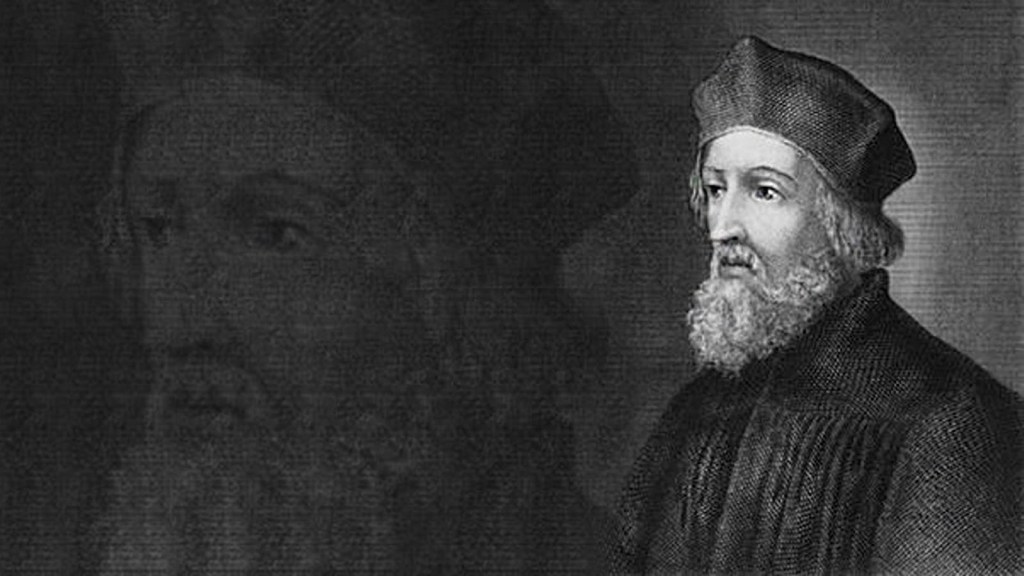
By Dr. John Hill,
John Hus, more correctly named Jan Hus, was a Czech theologian and philosopher. After John Wycliffe, Hus is considered by Christian history to be the second Church reformer, preceding reformers such as Martin Luther, John Calvin, and Ulrich Zwingli.
Hus was born into poverty and took his name from his place of birth, Husinec, Bohemia (aka: “Goosetown,” with “Hus” meaning “Goose.” -more on this later). His birth date is disputed, but it is generally held that he was born around 1369. Hus entered a monastery at age 10 to escape poverty and devote himself to God. Later he moved to Prague, where he maintained a simple lifestyle and preaching, singing, and serving in various local churches. After earning his bachelor’s degree, he was ordained as a priest and began preaching full-time in Prague. During his ministry, he began to take issue with some of the Catholic Church’s teachings, namely, the sale of indulgences.
As mentioned in previous articles, indulgences were the Catholic Church’s efforts to build wealth and fund building projects. Wealthy citizens could purchase indulgences for themselves or family members to limit their time in purgatory after death. Hus, Wycliff, Luther, and Calvin all vehemently despised this practice, and it became known as “simony.”
Hus argued against the ecclesiology of the Catholic Church, meaning its church government. He believed that Christ was the head of the Church and not the Pope and denounced the moral failings of clergy, bishops, and the popes. He testified that reformation would not come to the Church through cardinals or other religious leaders because they were corrupt. The only way the Church would be reformed is by educating the laity and by faithfully preaching the Word of God.
Hus was an ardent proponent of Biblical preaching. He defended every minister’s right to preach the Bible rightly and freely without direction from religious leaders. At the time, these religious leaders used the pulpits of some preachers to control the people and influences their allegiance to kings, bishops, or popes.
Hus believed in the celebration of the Eucharist (communion) “under both kinds.” Many of us are not familiar with this phrase, but to the point, the bread was given to the laity and the wine (blood of Christ) reserved for the clergy. The Fourth Council of Lateran instituted this divided communion in 1215. Hus insisted laity were entitled to both the bread and the cup of Christ. Today, the chalice is one of the symbols used by denominations stemming from Hus’ influence.
After a great deal of political upheaval within the Catholic Church and the local government, Hus officially announced (October 18, 1412) his allegiance to Jesus Christ as Supreme Judge. By doing so, he was signifying to the world and his followers that he would no longer be under the constraint or control of the Pope nor the King of Bohemia. This act was the equivalent to when Martin Luther nailed the 95 Theses to the Wittenberg Door in 1517. These were significant events and would begin what would become the reformation of the Church.
On June 5, 1415, Hus was tried for the first time for heresy. He refused to defend himself but stated he would recant if any of his beliefs could be proven to him by use of the Scripture. He also celebrated John Wycliffe and stated that he wished his soul “might attain to that place where Wycliffe was.” The King, Sigismund, begged Hus to appeal to the mercy of the court, but Hus did not.
On July 1, 1415, Hus wrote these words (translated):
I, Jan Hus, in hope a priest of Jesus Christ, fearing to offend God, and fearing to fall into perjury, do hereby profess my unwillingness to abjure all or any of the articles produced against me by false witnesses. For God is my witness that I neither preached, affirmed, nor defended them, though they say that I did. Moreover, concerning the articles that they have extracted from my books, I say that I detest any false interpretation which any of them bears. But inasmuch as I fear to offend against the truth, or to gainsay the opinion of the doctors of the Church, I cannot abjure any one of them. And if it were possible that my voice could now reach the whole world, as at the Day of Judgment every lie and every sin that I have committed will be made manifest, then would I gladly abjure before all the world every falsehood and error which I either had thought of saying or actually said!
I say I write this of my own free will and choice.
Written with my own hand, on the first day of July.
At the last trial, June 8, 1415, Hus was accused of 39 heresies. As before, Hus stated he would willingly recant if anyone could prove his error by use of the Scriptures. No one was able to prove his error, but the council was set on conviction. On July 6, 1415, Hus was led into the cathedral to be given one more opportunity to recant. Hus responded, saying, “even at this hour, I do not wish anything but to be convinced from scripture.” He fell upon his knees and asked God to forgive his enemies.
He was then taken by his captors, dressed in his priestly vestments, and asked again if he would recant. Hus refused, and leaders began to curse him as they ripped off his garments (defrocking). A tall paper hat was placed on his head inscribed with the word meaning “leader of a heretical movement.”
At the place of execution, Hus prayed while the executioner undressed Hus and tied his hands behind his back. His neck was bound with a chain and linked to a large stake around which were placed wood and straw stacked to Hus’ neck. The imperial marshal asked once more for Hus to recant, but Hus declined, stating, “God is my witness that the things charged against me I never preached. In the same truth of the Gospel which I have written, taught, and preached, drawing upon the sayings and positions of the holy doctors, I am ready to die today.”
When Hus was about to succumb to death, he cried out, “Christ, son of the Living God, have mercy on us!” Hus’ ashes were collected and thrown into the Rhine river to prevent a proper funeral and for any of his followers to worship his remains. It is recorded that members of the council, jovial at Hus’ demise, exclaimed that the “goose was cooked.”
Hus’ followers organized into several fractions; today, Moravians are the largest, with smaller groups of “brethren” meeting throughout the Czech Republic and a small group in Texas, USA. Two symbols are incorporated into the logos of these groups: a chalice and a goose.
Bibliography
Matthew Spika. John Hus: A Biography. (Princeton Legacy Library: Princeton, NJ) 2017.
Oscar Kuhns. John Huss: The Witness. (Jennings and Graham, New York.) 1907
Thomas A Fudge. The Trial of Jan Hus: Medieval Heresy and Criminal Procedure, Oxford University Press, New York, 2013
Modern History Sourcebook. “Jan Hus: Final Declaration, July 1, 1415.” Accessed January 10, 2021 at https://sourcebooks.fordham.edu/mod/1415janhus.asp

 J.Hill Works, LLC