“The Queen of Gospel Song Writers”
Blumhofer describes Crosby as “the most prolific of all nineteenth-century American sacred songwriters” and was identified in the Gospel Hall of Fame as “The Queen of Gospel Song Writers.” By the end of her long writing career, Crosby completed almost 9,000 hymns and sacred poems. She was so well written and often published that publishing companies encouraged her to write under a pseudonym to keep from saturating the market with her compositions. It is estimated that Fanny Crosby’s contributions were published in more than 100 million unique publications.
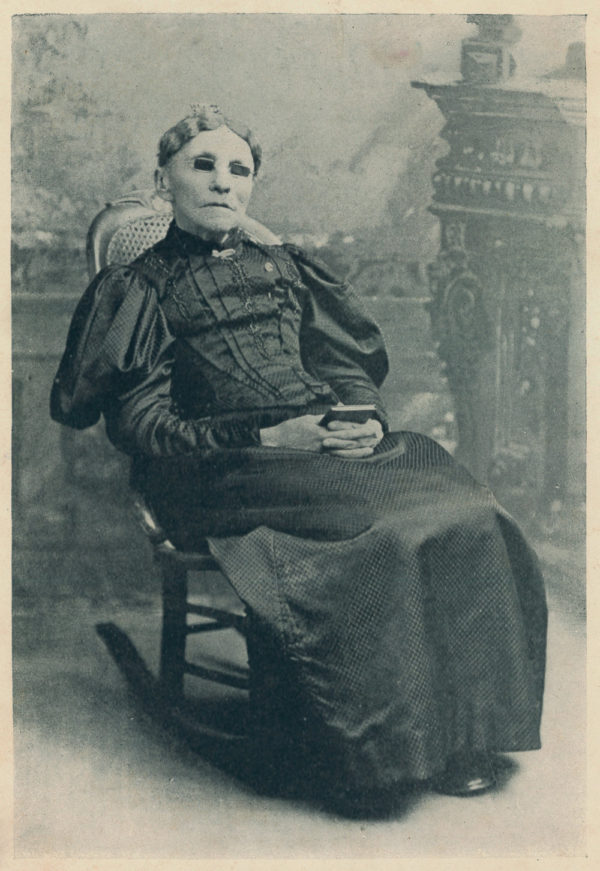
Hawkinson noted that Crosby set a goal for herself to win one million people to Christ through her hymns and sacred writings. Every time she wrote a poem or hymn, she prayed that it would bring men and women to Christ. While traveling with various evangelists and preachers, she kept detailed notes of the individuals who responded to salvation’s call through the singing of one of her hymns. Many of us will agree, Fanny Crosby achieved her goal many times over!
Her hymns were so notable that publishers avidly included her work in countless publications. William Bradbury, the author of “Jesus Loves Me,” published Crosby in the Golden Censer (1864), a Sunday School songbook that sold over three million copies. Biglow & Main Company contacted Crosby to write three songs per week, purchasing some 5,900 songs published by both Bradbury and Biglow & Main. Phillip Phillips, a Methodist publishing company, commissioned pieces based on the Pilgrim’s Progress, a set totaling 525 hymns.
Frances Jane Crosby was born March 24, 1820, in Brewster, New York. She was the only daughter of John and Mercy Crosby. They were Puritans and had family lineage connecting her to those settling in Boston after the landing of the Mayflower. Other family members went on to help establish Harvard College and others who began great preachers and leaders throughout the early American years. Others in her family tree include recent notables such as “Bing” and Bob Crosby.

Biographers, listed below, record that Fanny became ill at six weeks old and developed an infection/inflammation of the eyes. It is debatable if the lack of treatment led to her blindness or if her blindness was not detected until after this time, but when later examined by the renowned surgeon Valentine Mott, they concluded her blindness was permeant.
Crosby wrote her first poem at eight years old, describing her blindness as, “it seemed intended by the blessed providence of God that I should be blind all my life, and I thank him for the dispensation. If perfect earthly sight were offered to me tomorrow, I would not accept it. I might not have sung hymns to the praise of God if I had been distracted by the beautiful and interesting things about me” (Blumhofer, 1-14).
In 1828, Blumhofer tells that from age 10 to 15, Crosby memorized five chapters of the Bible each week. By the time she turned 15 years old, she had memorized all four gospels, the first five books of the Old Testament, the entire book of Proverbs, many of the Psalms, and the Song of Solomon. At 15, she enrolled as a student at the New York Institution for the Blind (NYIB) and later learned to play the piano, organ, guitar, and a singer.
Shortly after graduating from the NYIB, Crosby became a political lobbyist in Washington, D.C., advocating for care and education for the blind. She became the first woman to speak in the United States Senate when she recited one of her poems before a joint session of Congress, January 24, 1844. This would be only the first of her several appearances before Congress, political rallies, presidents, and presidential hopefuls.
In 1843, Fanny met Alexander van Alstyne, who was also a student at the NYIB. Both of them were instructors at the NYIB until their wedding on March 5, 1858. Alexander insisted that his new wife continue to use her maiden name when writing her hymns and poems but agreed that she would use van Alstyne when signing legal documents. However, historian Blumhofer states in her work that “despite (Fanny’s) education, her handwriting was barely legible, and on legal documents she signed with an X.”
Alexander and Fanny had one child, a daughter named Frances, who died from SIDS. It was during this terrible time of mourning and loss that Fanny wrote the hymn “Safe in the Arms of Jesus” ~ “Safe in the arms of Jesus, safe on His gentle breast, there by His love o’ershaded, sweetly my soul shall rest.”
Later in her life, around the age of 60, Crosby invested her life and ministry into mission work among the poor, homeless, orphaned, imprisoned, and forgotten. While speaking at the Manhattan prison in 1868, she was inspired to write the hymn “Pass Me Not, O Gentle Savior.” The hymn was a monumental success and was used by the revivalists Ira Sankey and D.L. Moody while traveling on their gospel crusades throughout American and England.
While attending a weekly meeting at a mission point organized by the New York City Mission, it is reported that a young man accepted Christ as Savior after hearing Crosby share her testimony with those in attendance. From those experiences, she wrote the “Rescue the Perishing” ~ “Rescue the perishing, duty demands it; strength for thy labor the Lord will provide; back to the narrow way patiently win them; tell the poor wander a Savior has died.”
Ira Sankey wrote in his 1907 memoir, “Fanny Crosby returned one day from a visit to a mission in one of the worst districts in New York City, where she had heard about the needs of the lost and perishing. Her sympathies were aroused to help the lowly and neglected, and the cry of her heart went forth in this hymn, which has become the battle cry for the great army of Christian workers throughout the world. It has been used very extensively in temperance work, and has been blessed to thousands of souls.” (Sankey, Ira D. My Life and the Story of the Gospel Hymns. 1907) 258–59.)
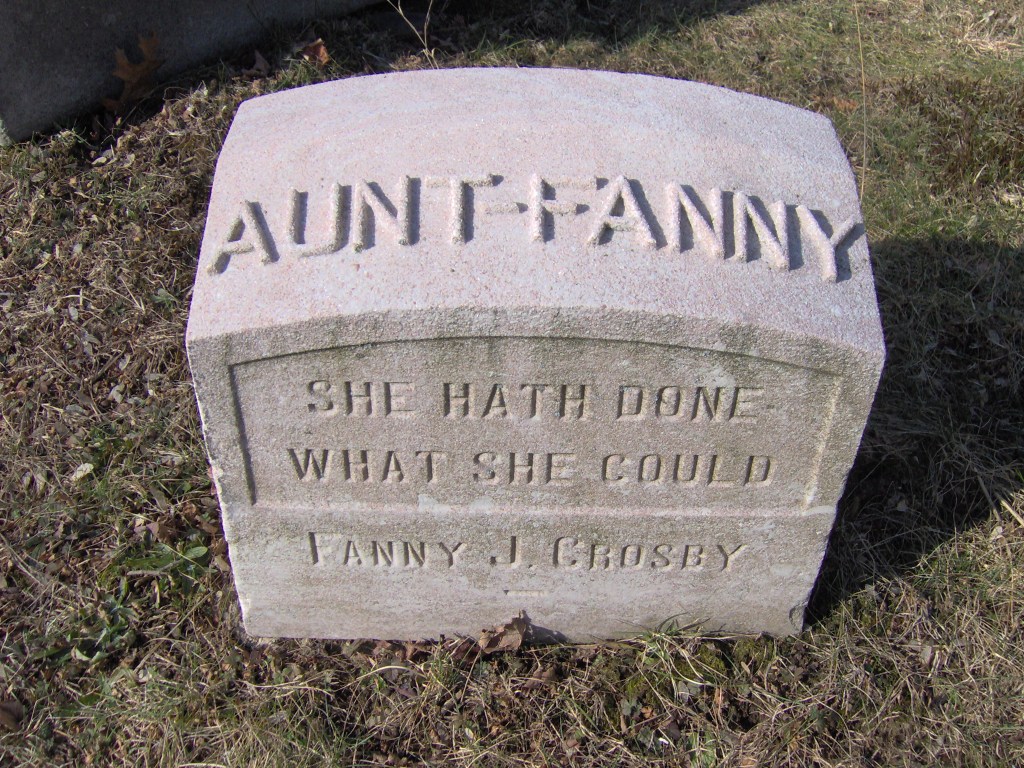
Fanny Crosby suffered for several months (possibly years) with a heart condition that limited her travel and overall wellbeing. At some point in her later years, Crosby fell and struck her head. The fall had long-lasting effects and eventually (likely) contributed to her death. Doctors ruled her death to be from “arteriosclerosis” and a “cerebral hemorrhage.” Crosby died on February 12, 1915, in Bridgeport, Connecticut, at the age of 94. Online resources show a picture of a simple tombstone that reads, “Aunt Fanny: She hath done what she could; Fanny Crosby.” The simple marker has since been removed and replaced with a more significant memorial to her legacy.

Space will not allow a full and fitting summary of Fanny Crosby’s life, ministry, and work. However, the works that provided the basis for this summary are available at the Joyner Library at East Carolina University Library and the Shepard Memorial Library in Greenville, NC.
Edith L Blumhofer. Her Heart Can See: The Hymns and Life of Fanny Crosby. (Grand Rapids, MI: Eerdmans, 2005).
Don Hawkinson. Character for Life: An American Heritage: Profiles of Great Men and Women of Faith who Shaped Western Civilization. (Green Forest, AR: New Leaf Publishing Group, 2005).
Mel R. Wilhoff. “Crosby, Fanny Jane.” In McNeil, W. K. (ed.). Encyclopedia of American Gospel Music. (Philadelphia: Routledge, 2005). Hymnary.org. “Fanny Crosby.” https://hymnary.org/person/Crosby_Fanny. Accessed November 15, 2021.

 J.Hill Works, LLC