
We set up some benchmarks to remember how far we have come as we begin a new year. Some of us have come through considerable difficulty, others of us have enjoyed some unexpected blessings, but all of us must make a benchmark.
I have done this many times throughout my life. The old hymn refers to raising an “ebenezer,” or a stone of remembrance to remind us of just how far God has brought us. Just think how far you have come and how much life has changed since 2020. We all need to erect a monument to help us remember and celebrate God’s provision, justice, and grace. This year’s issues will focus on a few beloved hymns of the Church, so I selected “Praise Him, Praise Him” by Fanny Crosby as the focus for the January/February issue for this reason.
We need to learn to praise God outside of the walls of our sanctuary. Psalm 150 comes to mind. Praise Him in the sanctuary, but also out under the firmament of heaven! Praise him quietly and reverently, but also praise Him with instruments, loud crashing cymbals. Let everything that has breath praise the Lord, Hallelujah!
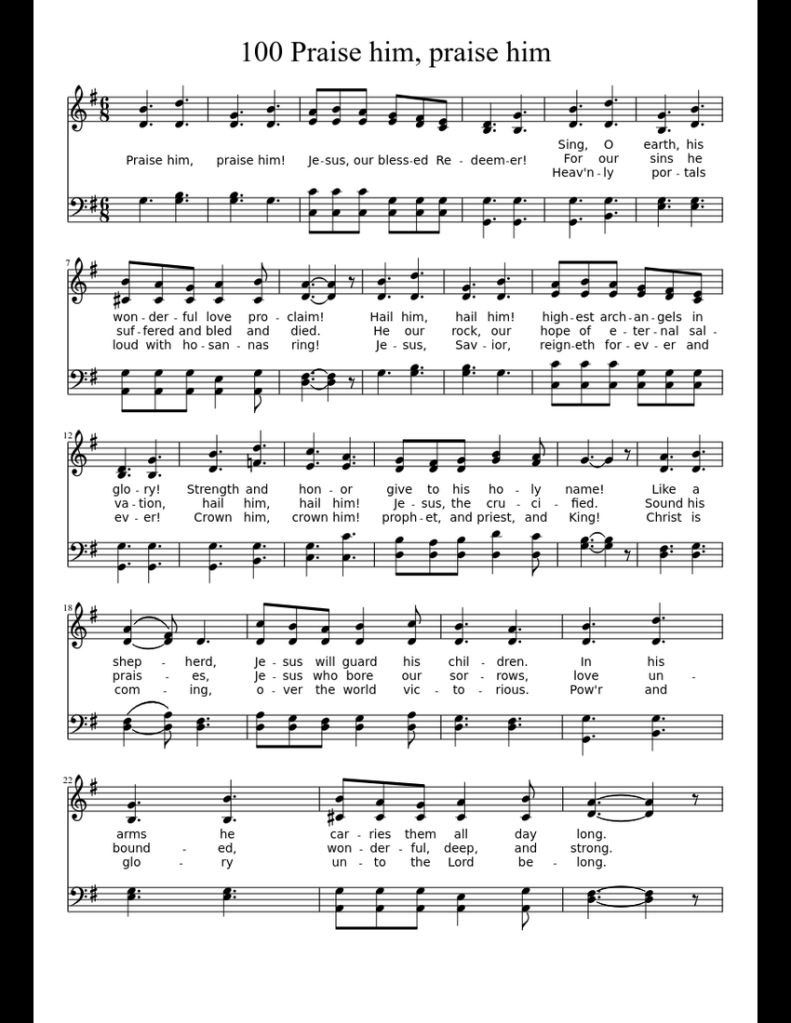
How often do you intentionally praise God outside of the church service? The psalmist encourages us all to glorify God in every station of life, no matter how big or small and in times of good or bad. God is interested in our significant and our mundane. So why not involve God in those times, too?
Praise has a way of lifting our spirits during difficult times. I recall how Paul and Silas were in prison (Acts 16), filthy, beaten, and in chains, but they were singing and lifting praise to God. If any of us had been unlawfully arrested, tried, beaten, berated, and thrown into prison, we would have plenty of time to reflect on our state. Many would blame God for their apparent misfortune. Others would become angry with God for allowing this suffering to befall them. Yet, Paul and Silas willfully shifted their minds toward praise, leaving no room for negativity or self-pity. Their act of worship invited God into their predicament and paved the way for God to do something miraculous—an earthquake that would set them free.
Don’t misunderstand that miracle. The earthquake was not to set them free—no, the purpose in the miracle was to redeem the jailer who had watched over them. Their praise was a witness to the jailer of the unspeakable joy Christians can possess. Their witness paved the way for the jailer to question and then accept this testimony of faith. Their praise prompted the jailer’s question, “Sirs, what must I do to be saved?”
The power of your praise could change your circumstances, but more importantly, it may lead others to a saving knowledge of Christ. For Paul and Silas, suffering was a part of their service to Christ, but their willful decision to praise led a jailor and his family to salvation. Even when you find yourself in an unbearable situation or in a mundane situation of no apparent significance or meaning—Praise Him, Praise Him!
Strength in the Lord comes from times of intentional praise. You can get through your challenge by praising Him! Human suffering and pain are a part of life, and we learn to appreciate the times of comfort, peace, and relief. Praising Him keeps the end in sight. It keeps us close to the heart of the matter. It keeps us mindful of his excellent greatness. Christ is coming, over the world victorious! Keep going! Keep Praising Him! He has brought us this far! Keep Praising Him, Ever In Joyful Song!

 J.Hill Works, LLC