“If I had a thousand pounds China should have it—if I had a thousand lives, China should have them. No! Not China, but Christ. Can we do too much for Him? Can we do enough for such a precious Saviour?” ~ J. Hudson Taylor
One of the greatest names in missions among evangelical churches is James Hudson Taylor. He was a spiritual hero who believed sincerely in the enduring principles of faith and prayer. He believed that God could influence people by prayer, and proclaimed through his example that it was no cowardly act to trust in the Almighty God. Taylor wrote, “There is a living God. He has spoken in His Word. He means what he says, and He is willing and able to perform what he has promised.”

Taylor’s life is quite similar to that of George Müller, Taylor’s long-time friend, and mentor. He learned so much from Müller about life, ministry, and missions. Interestingly, as Müller grew in notoriety, he continued to contribute to Taylor generously with financial and spiritual support. (Refer to the March/April issue of the Community Magazine for more on George Müller.)
James Hudson Taylor was born in Barnsley, Yorkshire, England, on May 21, 1832. His parents were devout Methodists and dedicated Hudson to the Lord at the local parish church. His father, James Taylor, was a pharmacist and lay speaker in the Methodist Church, and his mother, Amelia, was a homemaker. At the age of 16 (or 17), Taylor experienced an unusual conversion experience after reading a Gospel tract entitled “Poor Richard.” (You can read the tract online https://vdocuments.net/poor-richard-gospel-tract.html?page=2 or Google search “Poor Richard Gospel Tract,” or email the author for a PDF copy.) After giving his life to Christ, he committed to being a missionary to China.
Alfred Broomhall’s extensive biography on Taylor records that his mother was away in another city praying that Hudson would come to faith in Christ Jesus. Simultaneously, Hudson saw the Gospel tract, “picked it up, thinking to read the story and skip the moral, and was stuck on the phrase ‘the finished work of Christ,’ which came home to him in full force and with new meaning.”
To prepare himself for the mission field, Hudson studied medicine, surgery, and the Mandarin language. During this period of study, he moved from the University of Hull to the Royal London Hospital, Whitechapel, London, to continue his education. Still, before he left Hull, he was baptized by Andrew John Jukes of the Plymouth Brethren at the Hull Brethren Assembly in 1852. When he arrived in London, he chose to “live by faith” and moved into a tiny apartment in a rundown section of the city, eating [stale] bread and “brown apples.” He said if he could not live on the “bitterness of London,” he could not survive in China.
On September 19, 1853, Hudson boarded a ship in Liverpool (“Dumfries”) under the authority of the “Chinese Evangelization Society” (CES). He arrived on March 1, 1854 (five months later) in Shanghai, China. However, when he arrived, he was met by a bitter Chinese civil war halting much of his missionary efforts.
During this period, the CES failed to provide his $400 per year support, and it forced him to depend on the hospitality of others. He was broken, downhearted, and poorly received by the local people. Hudson was despised for his traditional black pastoral robe, and the locals called him the “black devil.” He decided to shave his head, grow out a pigtail (queue), and wear traditional Chinese clothing. His fellow missionaries called him a “crack-pot” for taking such measures. Further, he adopted and cared for a Chinese boy named Hanban.

While traveling on mission in October 1856, he returned home to find that all his medical supplies had been burned in a fire, and whatever remained of his personal belongings were looted. Challenged and depressed, he received a supportive letter with some financial gifts from George Müller. Hudson moved to Ningbo and began the “Ningbo Mission” with four Chinese men: Ni Yongfa, Feng Ninggui, Wang Laijun, and Qui Guogui. (Wang Laijun later became a famous Chinese pastor, missionary, and Bible translator.)
In 1858, Taylor married Maria Jane Dyer, who was living in Ningbo and working at a girls’ school. They soon adopted another child, Tianxi, and later had a baby that died in infancy. They later had a daughter, Grace, born in 1859, and assumed leadership of the Ningbo hospital.
The hardships he faced in China caused a substantial breakdown of his mental and physical health. He returned to England in 1860 to recuperate on furlough. The Taylors took Wang Laijun along for the journey and introduced him to Charles Spurgeon and remained in England, translating the Bible into the Ningbo dialect. While in England, the Treaty of Tiensin was signed, opening the Chinese borders to international trade, the legalization of opium, and allowed Christian missionaries to inland Chinese territories.
According to Broomhall’s biography, “On a Sunday in June of 1865, [Taylor] was unable to bear the sight of hundreds of smug Christians in Brighton [England] enjoying the consultation of a Sunday morning service while 400 million people were perishing in China, he left the service and made his way to a deserted beach. There, in agony…, he surrendered to the Will of God, and the China Inland Mission (CIM) was born.” Taylor wanted two missionaries for each of the eleven closed providences and two for Mongolia. He wrote on the inside cover of his Bible, “Prayed for twenty-four willing, skillful laborers at Brighton, June 25, 1865.”
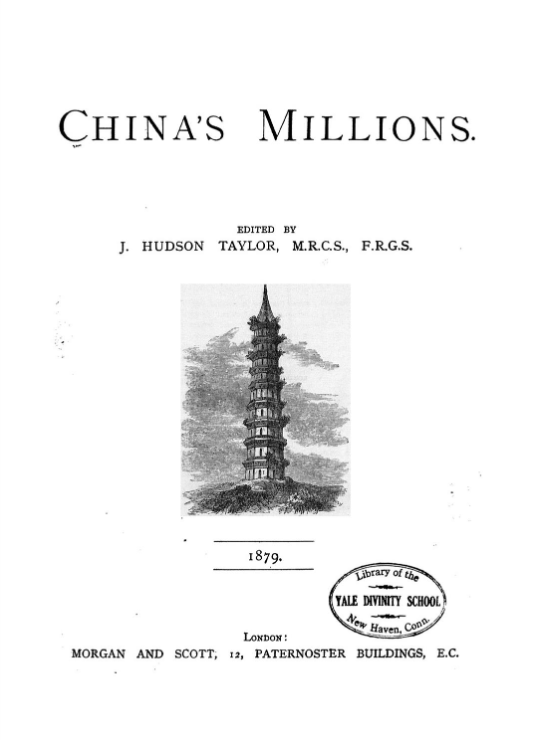
In less than a year, they recruited twenty-one missionaries and raised 2,000 pounds (about $200,000). After that, he published various works and his first edition of the Occasional Paper of the China Inland Mission, which later became known as China’s Millions. (Many of these items may be viewed for free via the Yale University Library online.)
Hudson Taylor returned to China in 1866 with a group of inexperienced missionaries, no denominational endorsement, and no visible means of financial support. People still thought of him as a “crack-pot,” but with no weapon but the truth of the Gospel, these young men and women went two-by-two to the Chinese interior regions against incredible hardship and opposition.
By 1882, all but three of the previously closed regions had resident missionaries. With such successes, calls went back to England for more missionaries. Soon, the China Inland Mission was the largest Christian mission to China, with over 1,400 missionaries and a membership of over 100,000 conversions.
Kenneth Latourette wrote in History of Christian Missions in China, “Hudson Taylor was, if measured by the movement which he called into being, one of the greatest missionaries of all time, and was certainly, judged by the results of his efforts, one of the four or five most influential foreigners who came to China in the nineteenth century for any purpose, religious or secular.
In 1867, the Taylors and the group of missionaries continued their quest deeper into China’s inland regions. They made their home in Hangzhou, China, and another daughter was born to them, Maria Hudson Taylor. Meanwhile, hundreds of Chinese were coming to Hudson for medical treatment and to hear the Gospel. Unfortunately, during this time, their daughter Grace developed meningitis and soon died.
The following year, the mission pressed deeper into China to the Yangzhou region. The missionaries faced incredible difficulties; their mission houses were burned and looted during a riot. There was international outrage for the riots and attacks on these missionaries, and Parliament called for an “immediate withdrawal of all Christian missionaries from China.” However, the Taylors and the mission group did not retreat. They continued their work, and hundreds were converted to Christ. [Some commentators and biographers believe this riot resulted from the missionaries’ anti-opium campaigns.]
In 1868, another child, Charles, was born, and in 1870 their eldest son, Samuel, died, and the family made the wise decision to send the eldest three children to live in England. In July 1870, another child, Noel, was born but died from malnutrition because unknowingly Maria could not produce sufficient breastmilk to sustain him. Maria died a short time after from cholera. Hudson, grieving and ill, returned to England to recuperate.
While living in England on furlough, Hudson Taylor married a fellow missionary Jane “Jennie” Faulding. The couple made multiple trips between England and China and had two more children, Ernest Hamilton and Amy. They also adopted the orphaned child of missionary George Duncan. Jennie remained in England with all the children in 1876, while Hudson and 18 new missionaries returned to China.
By 1881, there were 100 missionaries in the Chinese Inland regions. Later, the number grew to 225 by 1883 and added another 100 by 1887. In 1888, Taylor visited the United States and took 14 American missionaries with him. While on these recruitment tours, he befriended Cyrus Scofield (of the Scofield Reference Bible) and Dwight L Moody. Both men began financially supporting the China Inland Mission to fund further mission efforts.
Taylor later simi-retired to Switzerland with his wife, Jennie and formally resigned from the China Inland Mission in 1902. Unfortunately, Jennie died of cancer in 1904, and Hudson decided to return to China one last time. While reading a book, he died peacefully in an armchair in his home in Changsha, China. He was buried beside his first wife, Maria, near the Yangtze River.
Mark Bradly found that the cemetery was built over with industrial buildings, and all makers of the graves were destroyed. Nevertheless, the gravestone for Hudston Taylor was stored away in a crawlspace and later placed in a museum. The grave marker has been restored and re-erected with the following words:
“Sacred to the memory of the Rev. J. Hudson Taylor, the reverend founder of the China Inland Mission. Born 21 May 1832. Died 3 June 1905. ‘A MAN IN CHRIST’ 2 Cor XII:2”
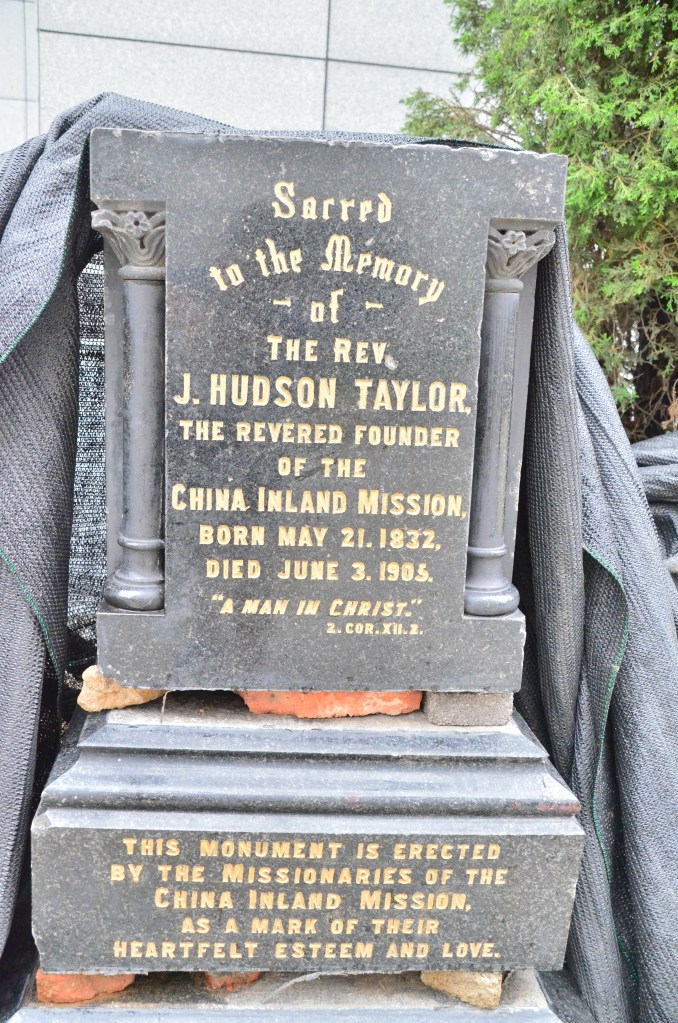
According to recent reports from 2013, the industrial building that was built over Hudson and Maria’s grave was demolished and revealed that the graves were untouched. Since that time, the graves have been reinterred into a graveyard at a local church. However, as of 2016, the official gravestone, though created, has still not been placed at the graves.
Hudson Taylor was a firm believer in the faithfulness of God. This was the cornerstone of his whole doctrine and message. Throughout his life, he depended on God to supply his needs, missionary personnel, and financial support for the missionary needs. He is noted to have stated that God’s mission carried on in God’s way would never lack God’s supply. We would all do well to remember such powerful precepts.
It would be a terrible mistake to believe that Hudson was a Hero of Faith without any mixture of difficulty or conflict. Funds dried up, riots ensued, opposition increased, death and disease were always present—and Taylor was often discouraged to the point of despair. Still, Hudson regularly relied on this faith and reported to others that with prayer and study, “God has made me a new man!”
Arthur F Glasser, a member of the CIM, said, “He was ambitious without being proud…he was Biblical without being bigoted…He was Catholic without being superficial…he was charismatic without being selfish.” Hudson Taylor was one of the truly greatest missionaries of the nineteenth century.
Resources
Broomhall, Alfred. Hudson Taylor and China’s Open Century. Vol. 1. Barbarians at the Gates. (London: Hodder & Stoughton.) 1982.
——— . Hudson Taylor and China’s Open Century. Vol. 2. Over The Treaty Wall. (London: Hodder & Stoughton.) 1982.
——— . Hudson Taylor and China’s Open Century. Vol. 3. If I had A Thousand Lives. (London: Hodder & Stoughton.) 1983
——— . Hudson Taylor and China’s Open Century. Vol. 4. Survivor’s Pact. (London: Hodder & Stoughton.) 1984
——— . Hudson Taylor and China’s Open Century. Vol. 5: Refiner’s Fire. (London: Hodder & Stoughton.) 1985
——— . Hudson Taylor and China’s Open Century. Vol. 6. Assault on the Nine. (London: Hodder & Stoughton.) 1986
——— . Hudson Taylor and China’s Open Century. Vol. 7. It Is Not Death To Die. (London: Hodder & Stoughton.) 1989
Unknown. Poor Richard. Gospel Tract. https://vdocuments.net/poor-richard-gospel-tract.html?page=4. Accessed March 24, 2023. Reprint published by J.K. Campbell, High Holborn. London.
OMF International. www.ofm.org. Accessed March 24, 2023.

 J.Hill Works, LLC