John Wesley was born June 28, 1703, in Epworth, North Lincolnshire, England. He was the fifteenth child of Samuel and Susanna Wesley. John was reared in a highly religious family; his father was an Oxford graduate, poet, and minister/administrator in Epworth. His mother was a daughter of Samuel Annesley, a minister in the English Separatists movement (out of the Church of England.)
Biographies report that Samuel and Susanna homeschooled their children, teaching them to be proficient in Latin and Greek. Others say that the children memorized large portions of the New Testament. Susanna would test the children twice a day (once before lunch and again before bed) to instill spiritual reflection and biblical knowledge in their children.
At eleven years old, John entered the Charterhouse School in London. This prestigious, publicly funded boarding school was established in 1611 for children thirteen to eighteen years old. (Today, the school is in Godalming, Surrey, England; its location since 1872.)

The biographer Charles Wallace reports that the family home, the “rectory” of Epworth, caught fire and was destroyed in 1709. Wallace writes that the roof caught fire, and calls from passersby woke Samuel and Susanna. They moved all the children to safety, except John, trapped on the upper floor. It is reported that two parishioners, standing on each other’s shoulders, climbed to the upper floor and saved John from the fire. John Wesley later stated, quoting Zechariah 3:2, that he was a “brand plucked out of the fire.” Perhaps John felt this salvation was indicative of a divine calling upon his life.
(Side Note: The rectory was later restored and today is a museum maintained by the British methodist conference of the World Methodists. Today the community offers “ghost tours” that tell the story of the haunted rectory. They claim the rectory was haunted by a male figure that John’s older sister Mehetable, named “Old Jeffery.” He was alleged to have been a traveler who disappeared in 1717. Almost every family member wrote about the ghost in their personal journals. Now back to the story already in progress…)
John entered Christ Church College at Oxford University. He earned his undergraduate and graduate degrees from Christ Church and was ordained as a deacon (the first level of ordination) on September 25, 1725. Later, in 1726, Wesley was elected a fellow at Lincoln College at Oxford and began teaching Greek, philosophy, and lecturing on various New Testament topics. However, amid his fellowship, John was called to return to Epworth to assist his father as minister of the church in the neighboring Wroot. He was ordained as a priest on September 22, 1728. After serving as a local pastor for two years, Wesley returned to Oxford to continue his fellowship.
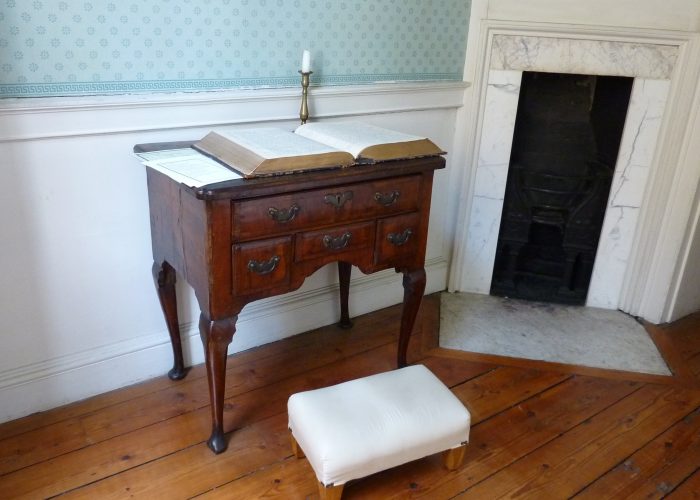
While John was always at Wroot, his younger brother Charles enrolled at Christ Church College. John, Charles, and two others formed a small club devoted to spiritual practice. They fasted, prayed, sang, and studied the Bible. They committed to taking Holy Communion every Sunday and fasted on Wednesdays and Fridays from waking to 3 pm. They committed to visiting prisoners in the local jail, preached and educated them, and often settled their debts in exchange for freedom. The men were labeled as religious fanatics by many at Oxford who gave them the name “Holy Club,” “Bible Moths,” “Supererogationists,” and “Methodists.”
Biographer Stephen Tomkins writes that the club came under greater scrutiny when a member of the club, William Morgan, suffered a mental breakdown and died. His antagonists perpetuated claims that regular fasting caused his death.
A hateful letter circulated through Oxford calling the men “the Oxford Methodists,” of which John gladly claimed the name that was initially a term of derision. John, Charles, and the others desired inner holiness that would be practiced in outward piety. John created (like the daily testing by his mother) a schedule (or “grid”) of daily actions, times, and his general “temper of devotion” on a scale of 1-9. His regular “grading” was a method to keep him focused on his goal of personal holiness.
John and Charles traveled, at the request of James Oglethorpe (founder of Georgia), to become the parish priest(s) in this new land. While crossing the Atlantic Ocean, a great storm came against the ship and broke one of the sailing masts. The Moravians on board the vessel calmly sat while singing hymns and offering prayers. Their spirit so moved John he began to reflect on his own spirit. Did he have the inner peace demonstrated by these Moravians?
John and Charles’ efforts in Georgia were unfruitful (by traditional evangelical standards), and the Wesley’s returned home to England. While sailing home, John began to reflect on this experience with the Moravians and their expression of faith. He questioned Peter Boehler, a Moravian missionary, and discussed his inner conflicts. Boehler is quoted to have said, “Preach faith until you have it.” John’s new message of a saving faith was not well received by many of his traditional congregants. Wesley suffered, what he called, his “Aldersgate experience.”

In May 1738, John attended a Moravian worship service at Aldersgate when, upon hearing a recitation of Martin Luther’s preface to Paul’s Epistle to the Romans, significantly changed the landscape of his faith, character, and mission.
Wesley wrote in his journal, “In the evening, I went very unwillingly to a society (Moravians) in Aldergate Street, where one was reading Luther’s Preface to the Epistle to the Romans. About a quarter before nine, while he was describing the change which God works in the heart through Christ, I felt in my heart strangely warmed. I felt I did trust in Christ, Christ alone for salvation, and an assurance was given to me that he had taken away my sins, even mine, and saved me from the law of sin and death.”
Wesley’s Aldersgate Experience was a significant experience for John and the entire Methodist movement. Without this “evangelical conversion,” the whole movement would have dissipated into oblivion. Today, some Methodist Churches observe “Aldersgate Day” on May 24.
John Wesley continued his relationships with Moravian pastors and leadership. He published hymnals for Moravian worship services and organized methods and protocols for providing leadership and quelling disagreement.
He rekindled with the preacher George Whitfield, who had also been expelled from the Anglican Church of England. Whitfield took to open-air preaching and encouraged John to do the same. Wesley was uncomfortable with this new approach because he believed the liturgy of the Anglican Church provided some spiritual (and educational) benefits. Still, he took to preaching in whatever venue would draw a crowd, even once in a cemetery using his father’s tombstone as his pulpit.
John’s “open-air” revival preaching was to call listeners to repentance and conversion. After communities would come to saving faith in Christ, houses of worship were organized to provide ongoing religious and spiritual education for disciples. As the number of societies grew, a more formal organization became greatly necessary. So, in 1743, John Wesley authored a set of “General Rules” for the “United Societies.” (These are the essence of the Disciplines that serve as the basis for the United Methodists today.) From these “General Rules,” a series of levels of leadership, societies, conferences, circuits, and annual conferences emerged.
John Wesley’s doctrine was self-hewn. He knew nothing of the works of Jacob Arminius but, arriving at his own conclusions found that it matched Arminius’ doctrine. Wesley later reported that “I and Arminius were in general agreement.” Generally speaking, John Wesley is the most prominent proponent of Arminian doctrine.
Biographer Stephen Tomkins writes, “Wesley rode 250,000 miles, gave away 30,000 pounds (money), and preached more than 40,000 sermons. He formed societies, open chapels, commissioned preachers, administered aid charities, prescribed for the sick, and superintended orphanages and schools.
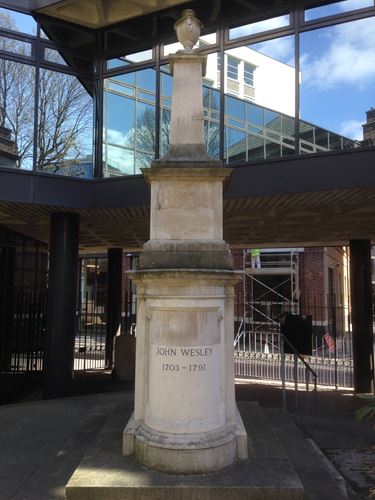
As Wesley neared the end of his life, his once strong substance waned, his eyesight darkened, and his overall countenance turned grave. As he lay dying, his friends gathered around him, Wesley grasped their hands and said repeatedly, “Farewell, farewell.” At the end, he said, “The best of all is, God is with us,” lifted his arms and raised his feeble voice again, repeating the words, “The best of all is, God is with us.”
John Wesley died on March 2, 1971, at the age of 87. He is entombed at the chapel at City Road, London.
Reference:
William J. Abraham. Wesley for Armchair Theologians. (Louisville: Presbyterian Publishing Corporation), 2005.
Kenneth J. Collins. A Wesley Bibliography. (Wilmore, Kentucky: First Fruits Press.), 2016.
J.F. Hurst. John Wesley the Methodist: A Plain Account of His Life and Work. (New York: Methodist Book Concern), 1903. Accessed Online: http://wesley.nnu.edu/john-wesley/john-wesley-the-methodist/ June 20, 2023.
Stephen Tomkins. John Wesley: A Biography. (Oxford: Lion Books), 2003.
Charles Jr Wallace. Susanna Wesley: The Complete Writings. (New York: Oxford University Press), 1997.

 J.Hill Works, LLC
