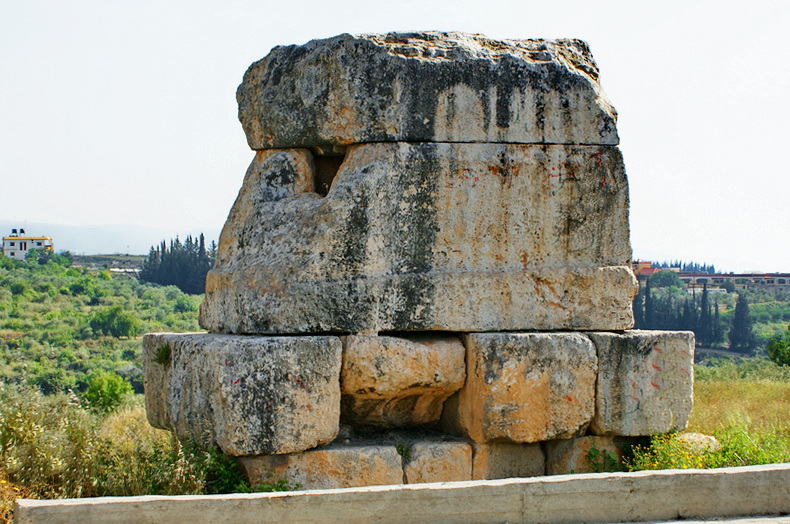
(Note: I presented on this topic at a recent meeting, and was asked to share the information for other friends and brothers. This existed in outline form, but I have tried to capture the essence in this longer blog post. The stone in the main image is the tomb of King Hiram I of Tyre.)
The name “Phoenicia” was first coined by the Greeks to describe the people from the land of Canaan. The term “Canaan” itself means “land of purple,” a reference to the region’s renowned purple dye industry, which flourished during the 17th and 18th centuries BCE.
Geography
Phoenicia was a long, narrow country along the Mediterranean coast, stretching 120-130 miles in length. The Lebanon Mountains formed a natural eastern border, with the River Nahr el-Kebir (the Dog River) to the north, Mount Carmel and Israel to the south. In some areas, the land was only 3-5 miles wide from the coast to the mountains. The narrow passage between Mount Carmel and the sea was strategically significant, leading Phoenician armies to focus on this area.
The land was fertile, producing evergreen trees and shrubs, wheat, barley, onions, garlic, figs, dates, olives, and grapes. Pine, oak, mulberry, beech, and cedar trees heavily forested the region. The coastal geography fostered a nation of sailors and pilots, giving rise to the first notable navy and extensive trade routes throughout the known world, potentially even reaching Britain. The chief product was purple dye, extracted from two species of sea snails, with large piles of discarded shells still found near Sidon and Tyre.


Notable History
Phoenicia’s history was marked by frequent wars, possibly driving its people to seek safety on the seas. Pharaoh Snefru recorded bringing 40 ships loaded with cedar from Phoenicia/Gebal around 3000 BCE. Unable to expand inland due to neighboring Arabs, Israelites, and Philistines, the Phoenicians turned to maritime trade, opening routes from Byblos to Egypt, Cyprus, Crete, Sicily, Thrace, Malta, North Africa (Carthage in 850 BCE), and Spain. Evidence suggests they traded as far north as Cornwall, England.

Phoenicia was defeated by the Assyrians around 677 BCE. After Assyria fell to Babylon in 612 BCE, Babylon destroyed what remained of Phoenicia in 572 BCE. King Cyrus of Persia defeated Babylon in 539 BCE, allowing the Phoenicians to return home. They paid no taxes to Persia but were required to provide naval assistance. Alexander the Great destroyed Phoenicia between 351-333 BCE. The Romans loosely maintained control from 64 BCE, with Phoenicia thriving under the Pax Romana, producing fine glass, pottery, metalwork, wine, dates, and wheat flour. Christianity spread into Phoenicia, as recorded in Acts 11:19; 15:3; 21:2.
Important Contributions
Phoenicia was instrumental in introducing writing at Byblos/Gebal and contributed significantly to the formation of the alphabet. (Gebel/Gebal/Gobel in Hebrew – Byblos in Greek)

Religion
Phoenician religion centered around the god “Bull El” and his wife “Asherah,” with a savior-like god named “Ba’al,” who was associated with fertility, rain, and thunder. King Hiram built a temple to Ba’al of Tyre (Melqart, also known as Dagon in 1 Samuel 5:1-7), a maritime deity. The Phoenicians practiced human sacrifices, with Melqart later known as Molech (Leviticus 18:21; 20:2-5; 1 Kings 11:7). Sacrifices were often made at “high places” accompanied by an Ashera Pole, with a constant fire burning to receive offerings.
Tyre
Located on a small island at the southernmost tip of Phoenicia, Tyre had a port on the south side of the island. King Hiram built the city around 1000 BCE. Although Assyrian kings claimed to have conquered Tyre, they could not access it due to its island location. Alexander the Great was the only one to conquer Tyre, constructing a half-mile-long and 200-foot-wide pier/causeway from the mainland to the island in 333 BCE. After a seven-month siege, the city fell, with 30,000 inhabitants sold as slaves and 2,000 leaders hanged.

Conclusion
Phoenicia’s strategic location, maritime prowess, and cultural contributions left a lasting legacy in history. From pioneering trade routes to influencing the development of the alphabet, Phoenicia played a crucial role in the ancient world.
George Buttrick, et all. “The Interpreter’s Bible Dictionary of the Bible: An Illustrated Encyclopedia Volume 3.” “Phoenicia” (Abingdon Press, Nashville, 2000). pp 800-805.
Ibid. “The Interpreter’s Bible Dictionary of the Bible: An Illustrated Encyclopedia Volume 2.” “Gebal.” pp 359.
Ibid. “The Interpreter’s Bible Dictionary of the Bible: An Illustrated Encyclopedia Volume 4.” “Tyre.” pp 721-723.
https://www.worldhistory.org/phoenicia/
